PACE knows the target, structure and performance anchor behind the session.
Adaptive half-marathon coaching · iPhone + Apple Watch
How fast can you really go?
You improve. Your training keeps up.
PACE brings your plan, workouts, analysis and race strategy together. It adapts your half-marathon training to the runs you actually complete, your readiness and your race date – through race day and into your next training block.
SOUND FAMILIAR?
You run consistently. It feels hard. But you're not getting faster.
If nearly every run feels similarly hard, effort often isn't the problem — a clear training stimulus is. PACE detects those patterns and turns them into training with direction: easy when easy matters, purposefully hard when the stimulus matters, more specific as race day approaches.
Why always running moderately hard can stall progress →


HOW PACE ADAPTS
You improve. Your training shouldn't stand still.
PACE uses your actual execution to recognize when a stimulus no longer matches your current level — and develops the next sessions from there.
Pace, heart rate, RPE and workout structure form a stronger picture together — not just one fast split.
When progress is confirmed, forecast and future pace targets can move closer to your current performance level.
As race day approaches, not only pace but the type of training changes: threshold, HM-specific work, long runs and taper take priority at the right time.
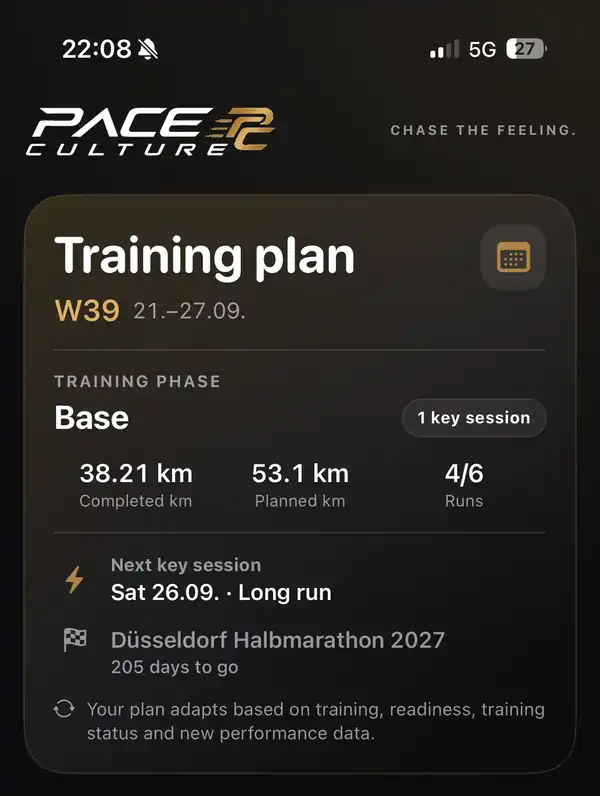
REAL APP · ONE TRAINING WEEK
Ease off when you need to. Train with purpose when you're ready.
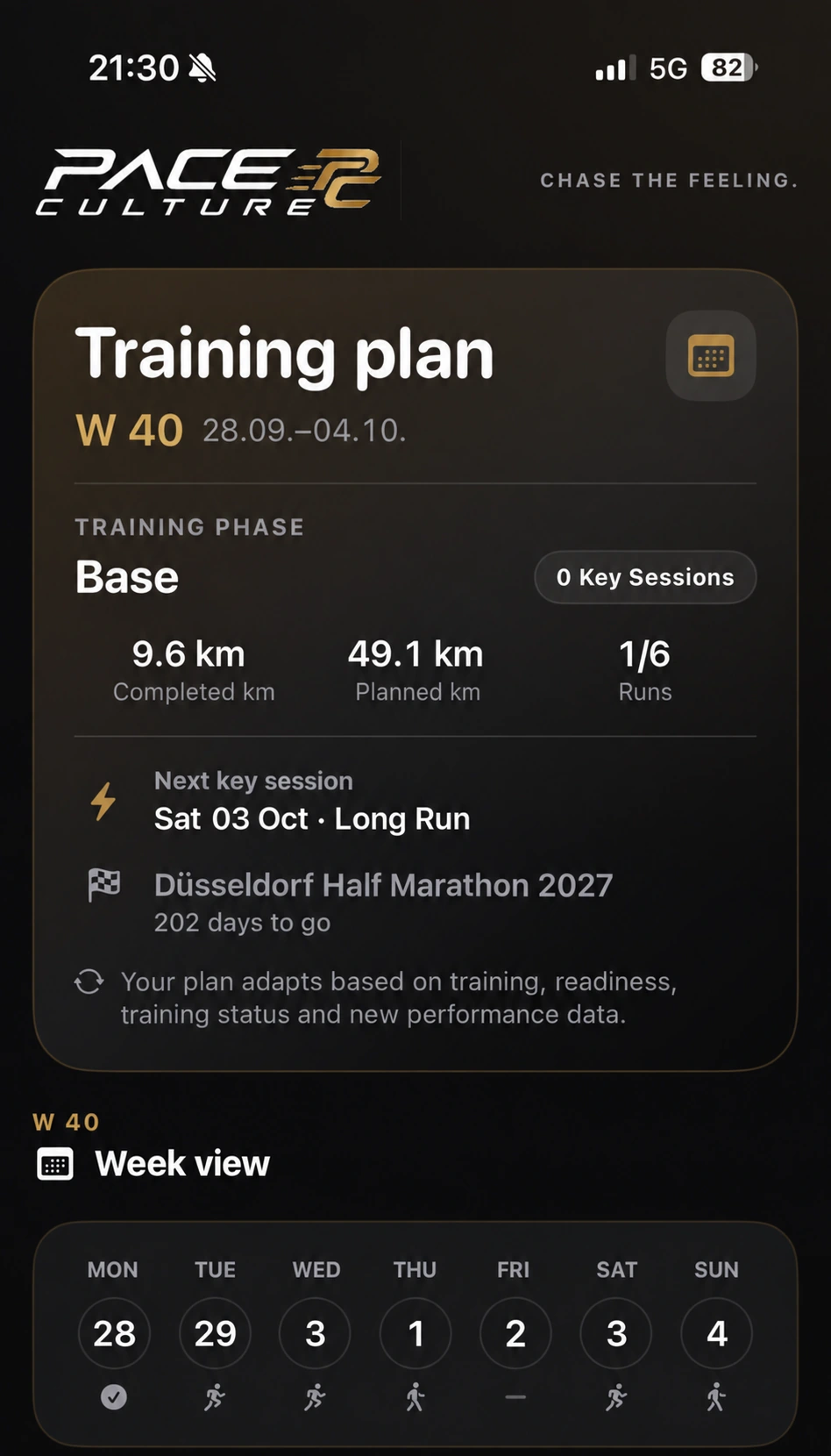
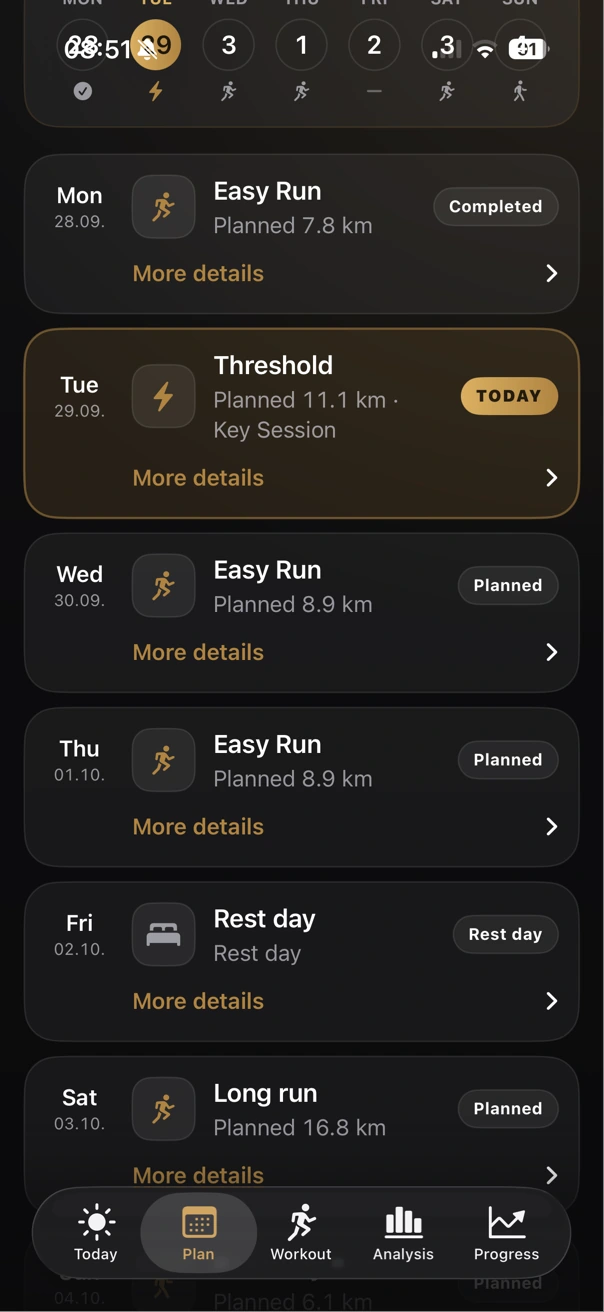
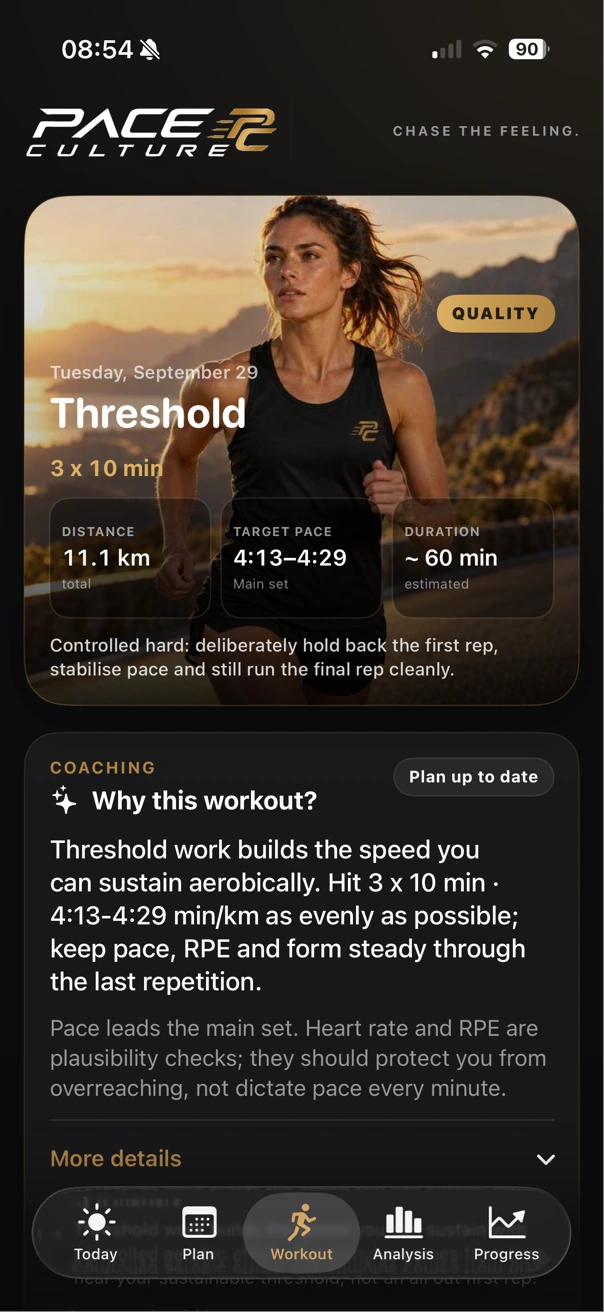
After fatigue and poor sleep, the plan showed no quality session for the week. Following a fresh recovery assessment, a threshold workout appeared the next morning, with a specific pace range and coaching rationale. These captures show one runner's experience, not a blanket rule to make up every missed quality session.
 View full image ↗
 View full image ↗
 View full image ↗
Captured 28–29 September 2026 from a real plan. The first image is an English text localization of the original German capture; dates and values are unchanged. Click an image to view it in full.
YOUR FIRST WEEK
What PACE feels like from day one.
You don't start at an artificial week one. PACE begins with your current training, race date and real availability.
Connect your history
If you choose to share them, PACE uses your existing Apple Health runs and recovery signals as a starting point.
Set race date & real life
Half marathon, goal, training days and available time give the plan direction and boundaries.
Run the workout
PACE shows the target range and reasoning. Structured workouts can sync to Apple Watch ready to start.
Reality feeds back in
What you actually ran, your current availability and relevant readiness signals feed into what gets planned next. This is where adaptation starts.
The goal stays your half marathon. The path can respond to what actually happens.
PACE ENGINE
Every session should move you closer to a faster half marathon.
PACE combines real training load, recovery, conditions, availability and race date. The next useful sessions grow from that — not from a weekly calendar that pretends nothing changed.
YOUR WEEK
More running isn't automatically better.
Your long run, quality sessions and weekly volume reflect your history and what you can currently handle. When progress is consistently confirmed, training can grow with it.
HM FORECAST
If you get faster, the forecast can move.
Confirmed races, tests and suitable training outcomes can update your performance forecast and future training paces.
HM FORECAST TODAY
1:24:xx
model-based · with transparent data quality
WEATHER & ROUTE · PACE ENGINE
The same pace does not represent the same performance in every condition.
PACE links each workout to its weather and route context. Heat, wind, elevation profile, gradient and altitude can affect how pace and load are interpreted. A deviation is therefore not automatically treated as poorer performance when the external conditions provide a plausible explanation.
That context stays linked to the workout and influences analysis, response and replanning. Pace is not judged without context.
Heat / temperature
Wind
Elevation / gradient
Altitude
Every feature, intelligence layer and signal at a glance.
Explore capabilities →
A concise view of what PACE does, what it considers, where it is used – plus a clearly marked roadmap.
READINESS · REAL APP
Readiness is more than a number.
Sleep, HRV, resting heart rate and how you feel are considered together. Easy, LT1 and Threshold stay visible so you can understand where your targets come from.
Sleep
HRV
Resting HR
LT1
Threshold


WORKOUT COACHING · REAL APP
Every workout has a purpose. And an explanation.
PACE doesn't just show distance, duration and target range. It also explains why that workout makes sense today, what to focus on while running and which common mistakes can dilute the training stimulus.
Target range
Why this workout?
Coaching Cues
Common mistakes


RACE DAY SYSTEM
Training doesn't stop at the start line.
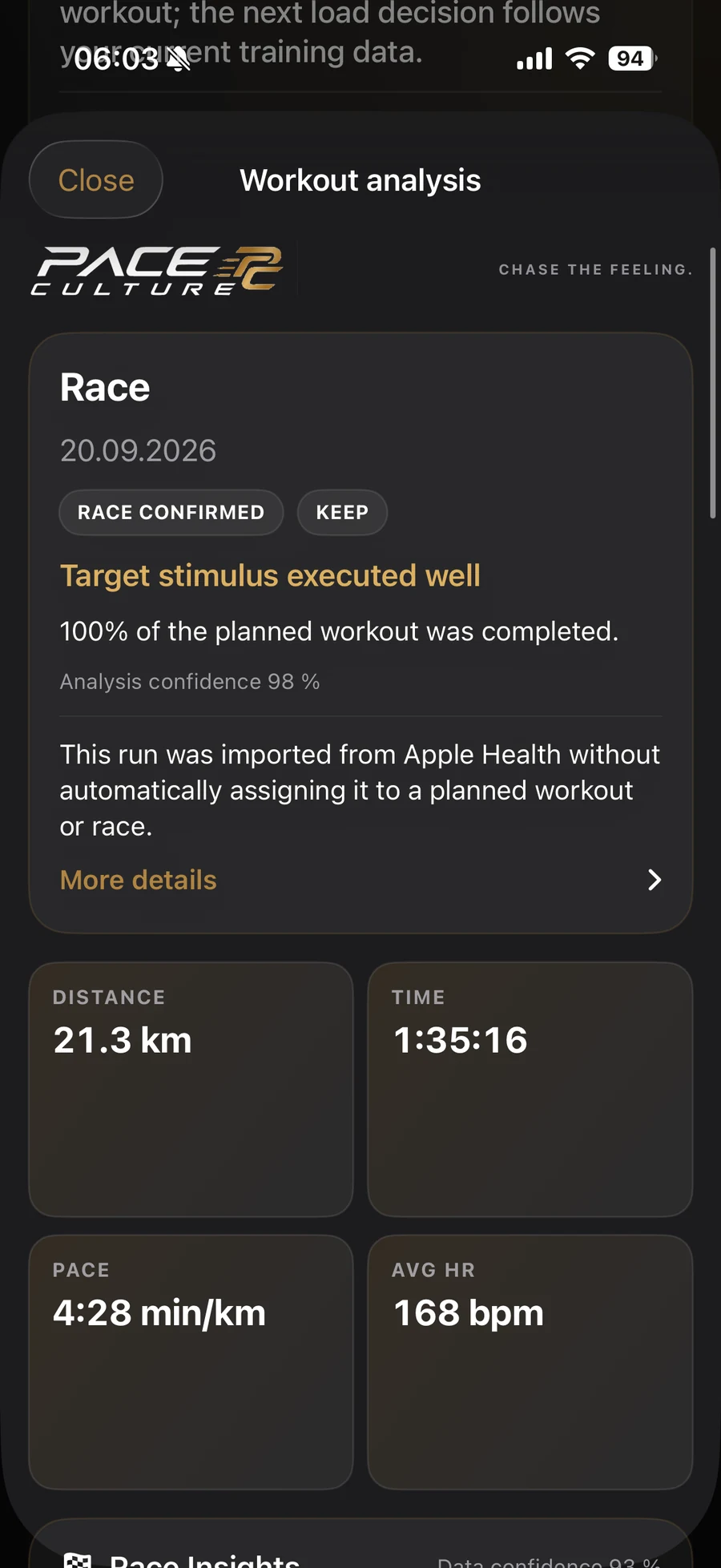
However much time remains until race day, PACE connects Race Readiness, Race Strategy and Race Insights. Your entire build becomes a concrete race-day decision — and the race becomes new knowledge for the next training block.
01RACEConfirm race
02ANALYSISPacing · HR · Late fade · Durability
03LEARNINGLimiter stays retained
04NEXT PLANPriority inside quality budget
05NEXT RACEStrategy uses what was learned
The race is not just stored. It can influence priorities in the next specific training block and your next race strategy — without simply adding extra hard sessions to the week.
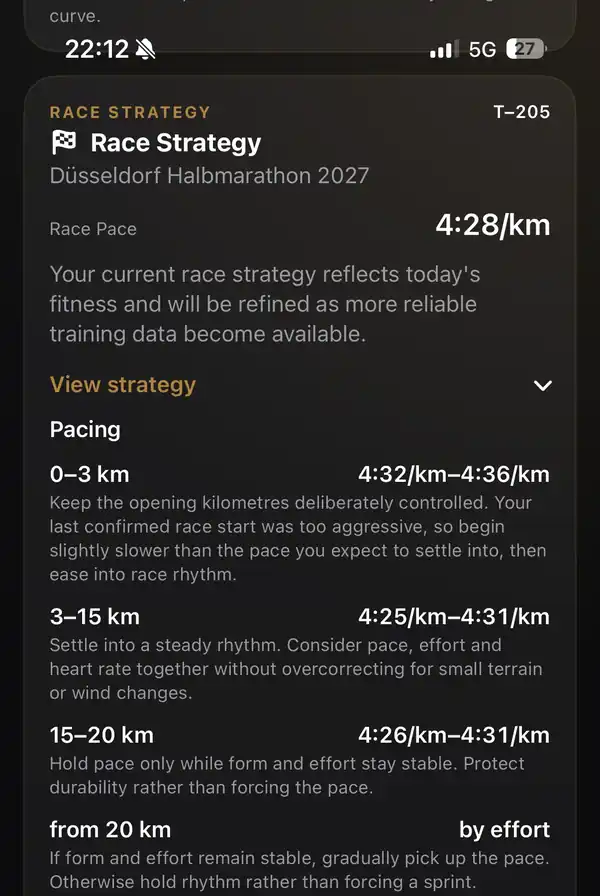
RACE STRATEGY · REAL APP
One plan for the 21.1 kilometres that matter.
Pacing, race cues and insights from the last confirmed race are combined into an actionable strategy.
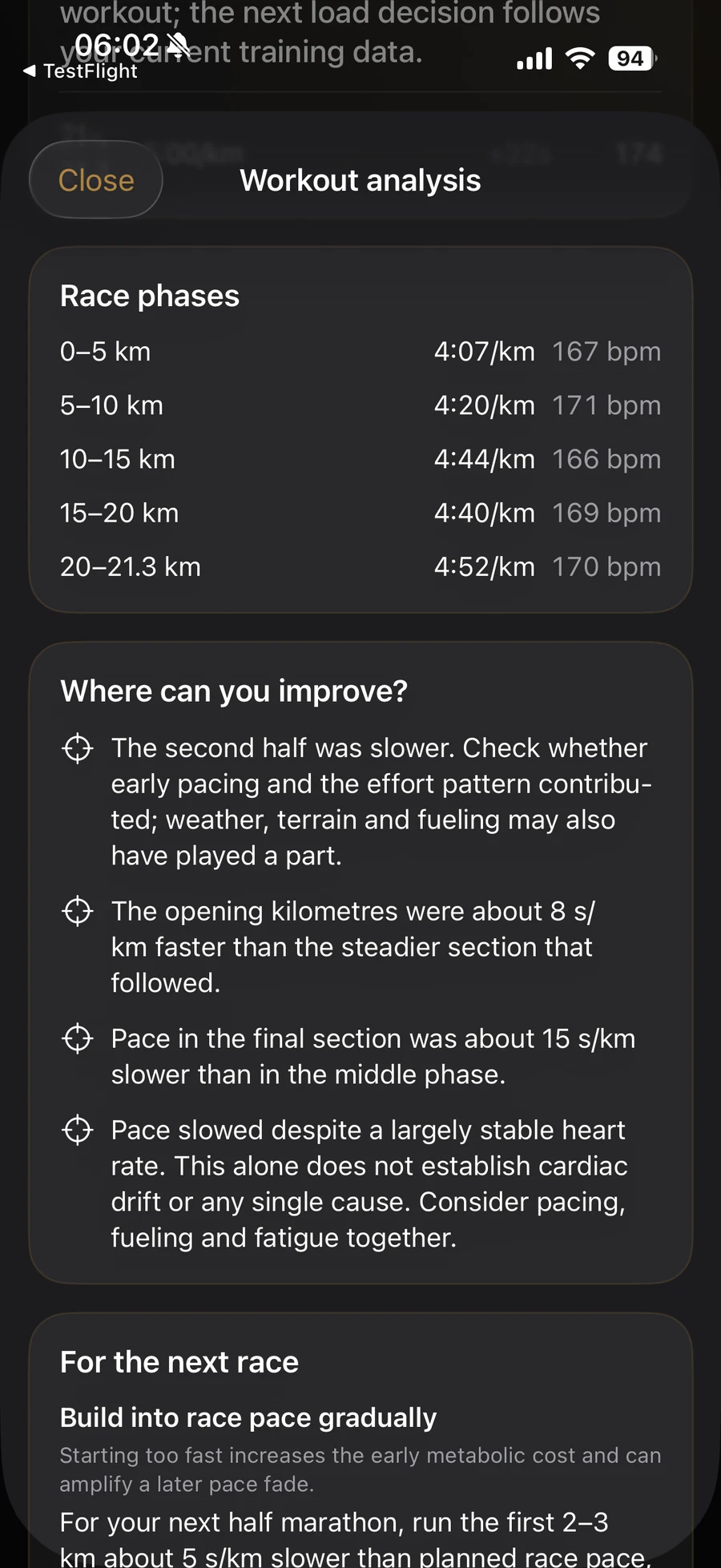
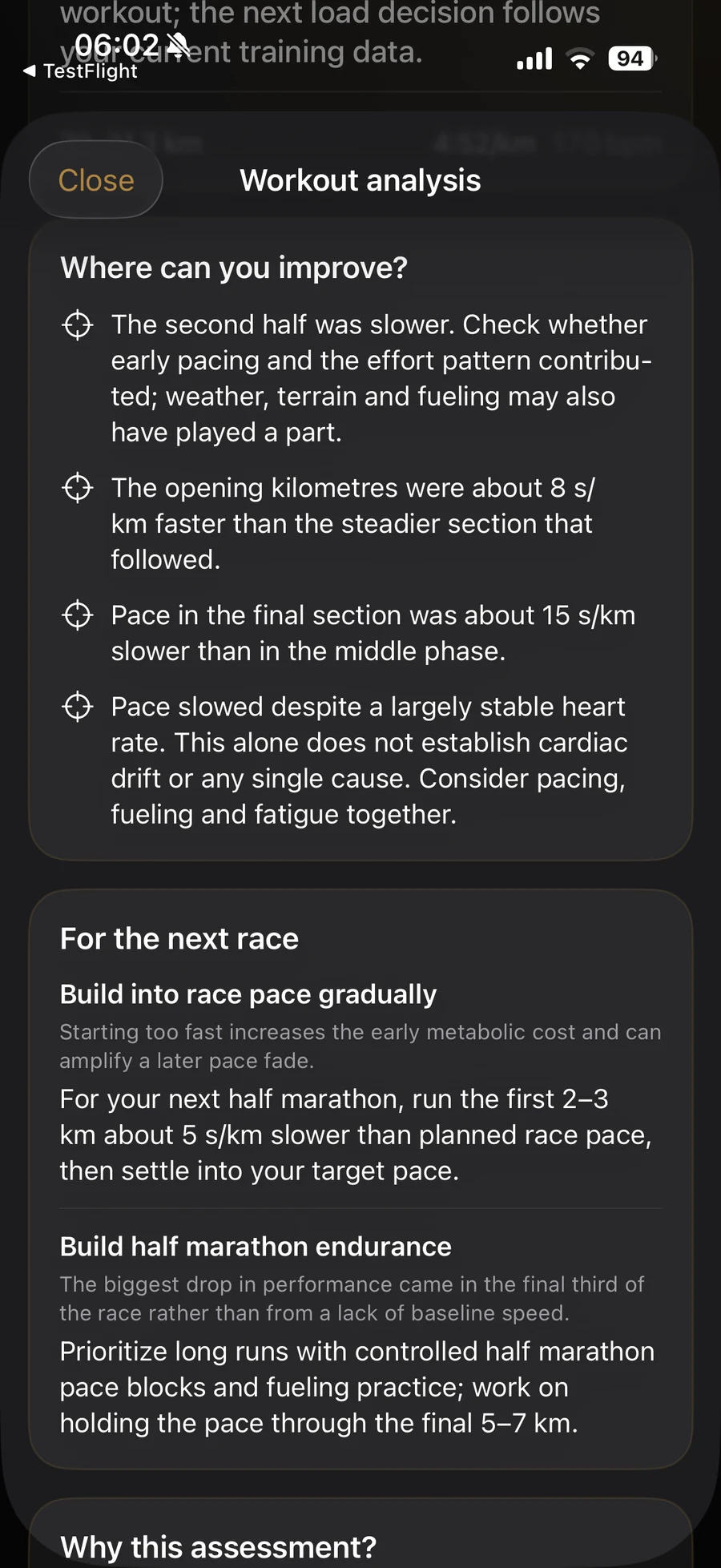
RACE INSIGHTS · REAL APP
Your race becomes the next training decision.
PACE goes beyond splits. Race phases, pacing, heart rate and late-race fade are interpreted together — then translated into specific priorities for what comes next.
FROM DATA TO COACHING
What happened? What may have contributed? What should change next?
PACE carries the analysis through to action: from race phases and late-race fade to possible contributors and specific recommendations for pacing, half-marathon endurance and your next race.
Race phases
Late fade
Heart rate
Durability
Next race
APPLE WATCH
The plan on iPhone. Execution on your wrist.
Your workout is planned on iPhone and arrives ready to start on Apple Watch. Structure, pace and heart-rate ranges go with it. When your training changes, the updated session is synced again.
- Structured workouts directly on Apple Watch
- Pace and heart-rate ranges on your wrist
- Plan adapted? The updated workout is synced again.

WORKOUT READY
Long run directly on your wrist


PACE CULTURE
CHASE THE FEELING.
Train with structure. Feel the progress. Arrive at the start line looking forward to race day.

PACE METHOD
Training science that shows up in your next session.
PACE turns training science into concrete decisions: which stimulus matters now, when your targets should progress with your performance and how training becomes more race-specific toward race day. Recovery and load tolerance support that development — they are not the end goal.
01Evidence-informed
02Systematically tested
03Explainable decisions
RUNNING INSIGHTS
Understand your training better.
Evidence-informed, practical background on training, recovery and race day — always focused on what it means for your training.
PERIODIZATION
Why every training week should not look the same
How volume, intensity and specificity shift toward race day.
Read article → WORKOUTSEasy, recovery, threshold, HM-specific & long run
What the main workout types are for and why every run should not feel equally hard.
Read article → RECOVERYSleep, HRV, resting HR, soreness & fatigue
Why a single readiness metric is not enough and subjective signals matter.
Read article → LONG RUNDurability: what remains after 80 minutes
Why performance under prolonged load is a factor of its own.
Read article →FAQ
PACE CULTURE TRAIN, briefly explained.
What is PACE CULTURE TRAIN?
PACE CULTURE TRAIN is an adaptive half-marathon training app for iPhone and Apple Watch. It develops upcoming sessions from your training history, readiness, availability and race date.
How is PACE different from a static training plan?
A static plan follows a pre-set calendar. PACE considers what you actually ran, how relevant training signals develop and when training is genuinely available.
How does PACE use Apple Watch?
Planned structured workouts sync from iPhone to Apple Watch, including pace and heart-rate ranges plus the workout structure.
What happens if I miss a run?
PACE does not automatically treat a missed run as mileage debt. The training context is reassessed so the next useful session remains the priority.
Can I use PACE for my first half marathon?
You do not need a previous half-marathon time. PACE uses your current running, race date and available training days. For now, the half-marathon plan assumes some running base; a dedicated run/walk path for complete beginners is planned.
Is PACE publicly available yet?
PACE is currently in early access. You can register your interest and will be notified when the next testing phase opens.
PACE CULTURE TRAIN
CHASE THE FEELING.
Bring your real training data, race goal and available time. PACE turns them into an adaptive path to the start line. Join the list for the next early-access testing phase.
Join the early-access list
Today: iPhone + Apple Watch · more wearables in preparation · Android planned for a later consumer-scale phase
hello@paceculture.de ↗